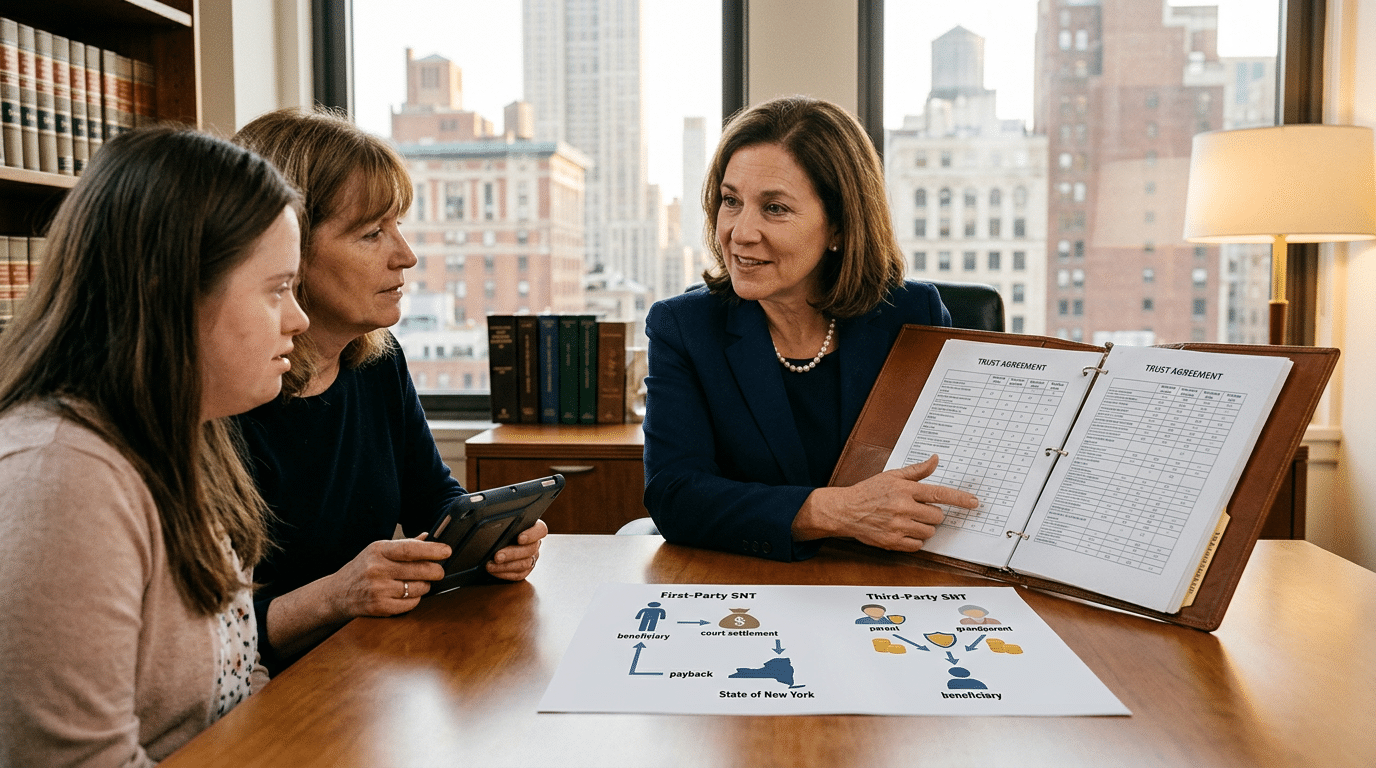
A special needs trust can be one of the most important estate planning tools available when a person with a disability receives, or may someday need, means-tested government benefits. However, not all special needs trusts work the same way. One of the most important distinctions we discuss with families is whether a trust will be funded with the beneficiary’s own assets or with assets belonging to someone else. That difference determines whether the trust is considered a first-party or third-party special needs trust, and it can significantly affect Medicaid reimbursement, how the trust is created, and what happens to the remaining assets after the beneficiary dies. Choosing the wrong structure or funding a trust incorrectly can jeopardize the very benefits the family intended to protect.
At Bernard Law P.C., we help families in Shoreham and throughout Suffolk County evaluate these issues as part of a broader estate plan. A properly structured special needs trust can allow a person with a disability to benefit from family wealth, personal assets, or a settlement without necessarily causing those assets to be treated as immediately available resources for certain government benefit programs.
New York Law Recognizes Supplemental Needs Trusts
New York generally uses the statutory term “supplemental needs trust.” New York Estates, Powers and Trusts Law § 7-1.12 provides the principal state-law framework for trusts created for people with severe and chronic or persistent disabilities.
The basic concept is that trust assets are intended to supplement, rather than replace, government benefits. The beneficiary generally cannot demand distributions or exercise control over the trust assets. Instead, a trustee is given discretion to use trust funds for the beneficiary in a manner consistent with the terms of the trust and applicable benefit rules.
This distinction matters because programs such as Supplemental Security Income and Medicaid generally impose financial eligibility requirements. Giving money directly to a beneficiary who receives means-tested benefits can create eligibility problems. Leaving the same assets to a properly drafted third-party supplemental needs trust may produce a very different result.
A special needs trust is therefore not simply an inheritance vehicle. It requires careful coordination between estate planning documents, beneficiary designations, public-benefit rules, and the family’s long-term objectives.
A First-Party Special Needs Trust Holds The Beneficiary’s Own Money
A first-party special needs trust is funded with assets that legally belong to the individual with a disability. Common examples include a personal injury settlement, an inheritance that was paid directly to the beneficiary, accumulated savings, or other property already owned by that individual.
Federal law under 42 U.S.C. § 1396p(d)(4)(A) establishes important requirements for qualifying first-party trusts. New York Social Services Law § 366 also addresses the treatment of these trusts for Medicaid purposes. A qualifying trust generally must be established for the sole benefit of a disabled individual who is under age 65 when the trust is established and funded, and it must satisfy applicable federal and state requirements.
The major tradeoff is Medicaid reimbursement. When the beneficiary dies, remaining trust assets generally must first be used to reimburse the state for Medicaid benefits paid on that beneficiary’s behalf, up to the applicable amount. Only after required reimbursement and permissible expenses are addressed can remaining funds pass according to the trust’s terms.
That repayment requirement is one of the most significant differences between a first-party and third-party trust.
A Third-Party Special Needs Trust Uses Someone Else’s Assets
A third-party special needs trust is funded with property belonging to someone other than the beneficiary. Parents and grandparents commonly create these trusts as part of their estate plans so that an inheritance can benefit a family member with a disability without being transferred outright to that person.
For example, parents might direct a portion of their estate into a supplemental needs trust for an adult child rather than naming that child individually as a beneficiary. The trustee can then manage and distribute those funds under the standards established in the trust.
New York EPTL § 7-1.12 specifically addresses supplemental needs trusts and reflects the principle that the trust should supplement rather than impair or diminish government benefits. The beneficiary generally cannot direct distributions or treat the trust assets as though they were personally owned.
A major advantage of a properly structured third-party trust is that the trust is ordinarily not subject to the same Medicaid payback requirement that applies to a qualifying first-party trust. When the beneficiary dies, remaining assets can generally pass to other family members or remainder beneficiaries selected by the person who created the trust.
That difference can preserve family wealth across generations.
The Source Of The Money Determines Which Trust Is Needed
Families sometimes believe they can simply place any assets into an existing special needs trust. That can be a serious mistake.
The source of the property matters. If parents are leaving their own assets for a child with a disability, a third-party special needs trust may be appropriate. If the child later receives a personal injury settlement belonging directly to the child, those funds generally cannot simply be deposited into the same third-party trust without potentially creating benefit problems.
This is why we focus carefully on funding when designing these plans. Beneficiary designations on life insurance, retirement accounts, investment accounts, and other assets must also coordinate with the trust.
A parent may have an excellent special needs trust in a will but accidentally name the child directly on a life insurance policy. At death, the insurance proceeds could then pass outside the estate plan and directly to the child, potentially affecting means-tested benefits.
Good planning requires the entire estate plan to work together.
Trustee Decisions Can Affect Government Benefits
Creating the right trust is only part of the planning process. Administration after the trust is funded is equally important.
Under EPTL § 7-1.12, the trustee generally exercises discretion over distributions and must consider the effect a payment could have on government assistance. Certain distributions may affect Supplemental Security Income or other benefits even when the existence of the trust itself does not.
The trustee therefore needs to understand more than ordinary trust administration. Before making significant distributions, the trustee may need to consider the beneficiary’s current benefits, living arrangement, other resources, and applicable program rules.
Families should select trustees carefully. A relative may know the beneficiary extremely well but have little experience administering a supplemental needs trust. Depending on the circumstances, professional assistance or a co-trustee structure may deserve consideration.
Frequently Asked Questions About First-Party And Third-Party Special Needs Trusts In New York
What Is The Main Difference Between A First-Party And Third-Party Special Needs Trust?
The primary difference is who owned the money before it entered the trust. A first-party trust contains assets belonging to the person with a disability. A third-party trust contains assets contributed by parents, grandparents, or other people. That distinction affects the legal requirements and what happens to remaining assets after the beneficiary dies.
Does A Third-Party Special Needs Trust Require Medicaid Payback?
A properly created and funded third-party special needs trust generally does not carry the same Medicaid reimbursement requirement because the assets never belonged to the beneficiary. The person creating the trust can ordinarily select remainder beneficiaries who receive what remains after the disabled beneficiary’s death.
Can Parents Leave An Inheritance Directly To A Child Who Receives Medicaid Or SSI?
They can, but doing so may cause serious benefit problems. An outright inheritance can become a countable resource for means-tested programs. We often consider directing the inheritance into a properly drafted third-party supplemental needs trust instead so the funds can be managed for the child’s benefit.
Who Should Serve As Trustee?
The trustee should be trustworthy, financially responsible, and capable of understanding the beneficiary’s needs and the rules affecting distributions. The trustee may be a family member, professional fiduciary, financial institution, or another appropriate person or entity depending on the family’s circumstances.
Speak With Our Shoreham Estate Planning Lawyer Today
Special needs planning requires much more than adding trust language to a will. We need to understand whose assets will fund the trust, which government benefits the beneficiary receives, how distributions should be handled, who should serve as trustee, and what should happen to remaining assets after the beneficiary’s death.
If you are considering a first-party or third-party special needs trust for yourself or someone you love, Bernard Law P.C. can help you understand the legal and financial differences before important decisions are made. Our law office is located in Shoreham, New York, and we serve clients throughout Suffolk County. Call our Suffolk County estate planning lawyer at Bernard Law P.C. at (631) 378-2500 to schedule a free consultation.