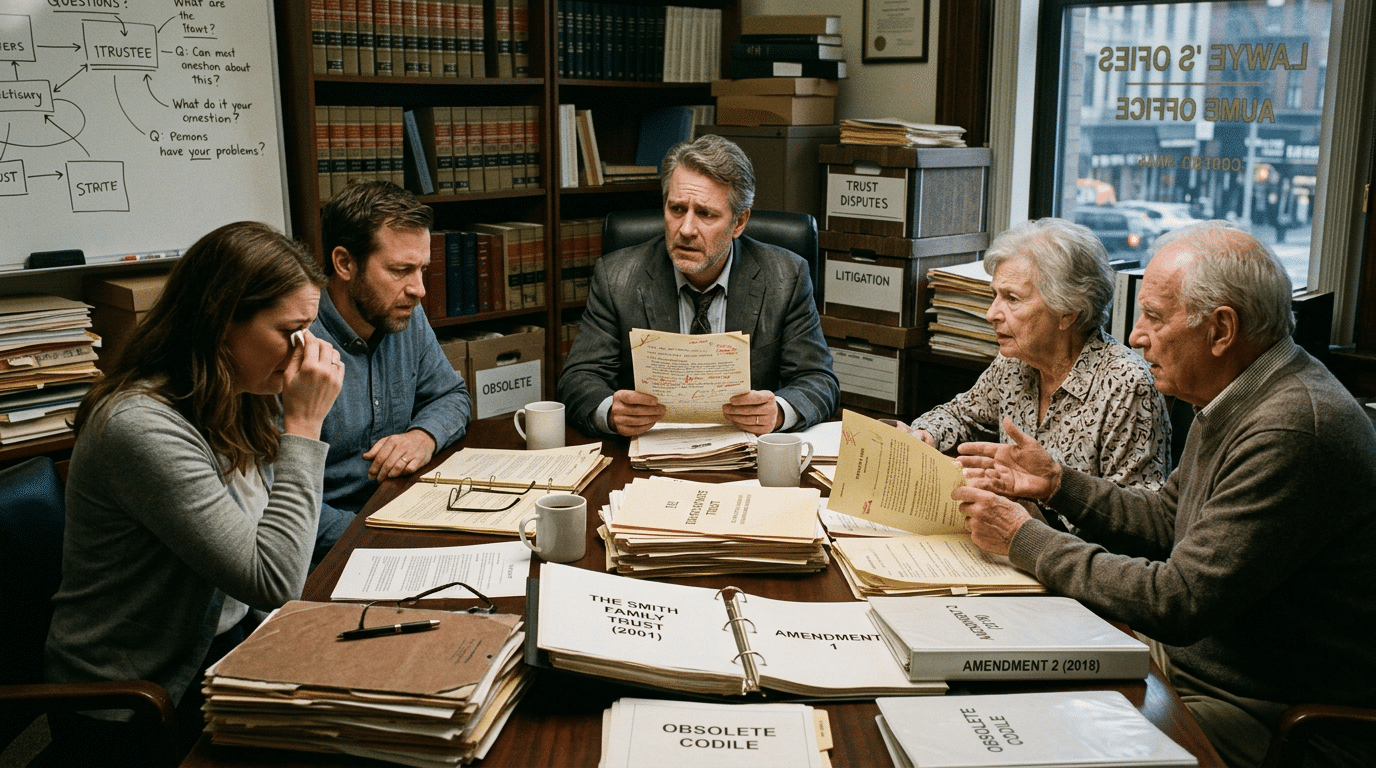
A trust can last for many years, but families, assets, tax laws, and personal situations often change over time. We often see trusts that were carefully written in the past but now include terms that no longer match the creator’s life or even conflict with other parts of the document. For example, a beneficiary might have passed away, a property could have been sold, a trustee may no longer be suitable, or two sections might tell the trustee to handle the same asset in different ways. These issues become especially important after the trust creator has died and cannot clarify their wishes. In these cases, the trustee usually cannot just pick the option that seems best and ignore the rest.
At Bernard Law P.C., we believe trust planning in Suffolk County should be flexible enough to handle changes. When a trust becomes outdated or inconsistent, the first step is to figure out what the document legally requires, what the creator likely intended, and whether New York law allows for changes or other solutions. For New Yorkers with property or legal ties to Florida, it’s also important to determine which state’s law applies and whether out-of-state assets create extra complications.
Outdated Trust Language Does Not Automatically Become Invalid
A provision does not become unenforceable simply because it is old, inconvenient, or no longer reflects what beneficiaries believe the creator would have wanted. A trustee has a fiduciary obligation to administer the trust according to its governing terms unless the document has been validly amended or a court authorizes a different course of action.
It’s important to know the difference between an outdated provision and one that is impossible to carry out. For example, if a trust says a Long Island home should go to a beneficiary, but the property was sold before the creator died, that instruction can’t be followed exactly. Another issue comes up if the trust still owns the property, but the family now wants to sell it. Just because a new plan seems more practical does not mean the trustee can ignore the trust’s instructions.
New York Estates, Powers and Trusts Law § 11-1.1 gives fiduciaries important powers to manage trust property, but these powers must be used according to the trust document and the law. If a trustee acts against the trust’s terms, beneficiaries may object and could even claim a breach of fiduciary duty.
For this reason, we generally recommend addressing questionable language before major distributions, sales, or transfers occur.
Contradictory Instructions Require Careful Interpretation
Some trust problems are more difficult because the document contains provisions that appear to conflict with one another. One section might direct the trustee to distribute an asset outright at a certain age, while another provision appears to require that the same property remain in trust for a longer period. An amendment drafted years later may also conflict with language that was never formally removed from the original document.
The legal analysis usually begins by reading the trust as a whole rather than isolating a single sentence. Dates of amendments, definitions used throughout the instrument, specific provisions addressing particular property, and the overall purpose of the trust can all matter. The objective is to determine the creator’s intent while giving effect to the document wherever possible.
Trustees should be particularly cautious about resolving genuine ambiguity on their own. Choosing between competing interpretations can materially affect the rights of different beneficiaries. A decision that increases one beneficiary’s share may necessarily reduce another beneficiary’s interest, creating an obvious potential for disagreement.
When uncertainty cannot be resolved through the governing documents and applicable law, judicial involvement may become appropriate. Obtaining a legal interpretation before acting can be considerably safer than completing a disputed transaction and attempting to correct it afterward.
A Revocable Trust May Be Easier To Correct During The Creator’s Lifetime
The available solution often depends upon whether the person who created the trust is alive, competent, and legally permitted to amend or revoke the trust.
New York EPTL § 7-1.17 establishes formal requirements for executing, amending, and revoking lifetime trusts. When a trust reserves a power of amendment or revocation, changes generally must be made in writing and executed according to the required statutory formalities. Simply writing notes in the margin, verbally telling family members what should happen, or assuming everyone understands the creator’s new wishes is not a substitute for a properly executed amendment.
New York law also contains procedures that may permit amendment or revocation in particular circumstances. Under EPTL § 7-1.9, for example, a trust creator may amend or revoke a trust with the properly acknowledged written consent of all persons beneficially interested, subject to the statute’s requirements.
This illustrates why regular trust reviews are valuable. If contradictory or outdated provisions are identified while the creator still has the legal ability to correct them, the problem may be resolved relatively efficiently. Once the creator dies or loses capacity, the available options may become considerably more limited.
Irrevocable Trust Problems Can Require Modification Or Court Involvement
An irrevocable trust presents a different issue because the creator generally cannot simply rewrite it whenever circumstances change. That does not necessarily mean an outdated trust can never be adjusted, but the legal analysis becomes more technical.
New York law provides certain mechanisms that may assist in particular situations. EPTL § 7-1.6, for example, permits a court under specified circumstances to authorize an invasion of trust principal when the trust’s original purpose cannot otherwise be carried out and the requested action would further the creator’s intent. Other trust arrangements may involve different statutory or judicial remedies depending upon the nature of the problem.
Courts generally place substantial emphasis on the creator’s intent. The goal is not to rewrite an estate plan simply because beneficiaries would prefer different terms. Instead, the question may be whether changed circumstances, ambiguity, impossibility, or another legal issue prevents the trust from functioning as originally intended.
Tax consequences must also be considered before modifying an irrevocable trust. An apparently simple change to beneficiaries, distribution rights, trustee powers, or ownership provisions may create gift, estate, income tax, or asset-protection consequences. This is particularly important for larger estates and trusts originally designed for tax planning.
New York And Florida Snowbirds May Face Additional Trust Issues
Trust administration can become more complicated when a New York resident owns a Florida residence or later establishes stronger connections with Florida. The trust may have been created under New York law years earlier while significant property is now located in Florida.
Florida has its own statutory procedures governing trust modification. Florida Statutes § 736.04113, for example, permits judicial modification of certain irrevocable trusts when circumstances not anticipated by the settlor would defeat or substantially impair a material trust purpose. Florida Statutes § 736.04115 also permits modification of certain trusts when continued compliance is not in the beneficiaries’ best interests, subject to statutory limitations and consideration of the settlor’s intent.
These rules do not mean that every New York snowbird trust can simply be modified under Florida law. Questions concerning governing law, domicile, trust situs, trustee location, and the location of trust property may need to be considered first.
For families with substantial connections to both states, coordinated planning can prevent an old New York trust, newly acquired Florida property, and later amendments from creating conflicting instructions.
Periodic Trust Reviews Can Prevent Future Disputes
Many trust disputes are not caused by poor intentions. They arise because a document created for one set of circumstances was never updated when those circumstances changed.
We encourage clients to review trusts after major events such as the death of a beneficiary or trustee, a marriage or divorce, the birth of grandchildren, the sale or purchase of major property, a significant increase in wealth, a move between states, or changes in tax law. The purpose is not to rewrite an estate plan every year. It is to identify provisions that no longer operate as intended before they become problems that surviving family members must solve.
A well-drafted trust should provide clear instructions, but even sophisticated planning cannot predict every future event. When trust language becomes outdated or contradictory, careful legal analysis can often determine whether the problem can be corrected and how to do so without creating a new one.
New York Trust Frequently Asked Questions
Can A Trustee Ignore An Outdated Provision In A New York Trust?
Generally, a trustee should not disregard a trust provision merely because it appears outdated or impractical. Trustees have fiduciary obligations to follow the governing instrument and applicable law. If compliance has become impossible, creates a genuine conflict, or appears inconsistent with another provision, legal interpretation or court relief may be appropriate before the trustee acts.
Can A Revocable Trust Be Changed If The Instructions No Longer Make Sense?
Often, yes, provided the creator still has legal capacity and the trust permits amendment or revocation. New York EPTL § 7-1.17 establishes formal requirements for amendments and revocations of lifetime trusts. Changes should be properly documented and executed rather than handled through informal instructions to family members.
What Happens If Two Trust Provisions Contradict Each Other?
The trust must usually be interpreted as a whole to determine how the provisions work together and what the creator intended. The date and language of later amendments may be important. If the conflict cannot reasonably be resolved, a trustee or beneficiary may need legal assistance or judicial guidance before distributions are made.
Can An Irrevocable Trust Ever Be Changed In New York?
Potentially. The answer depends upon the trust language, the nature of the requested change, the interests of the beneficiaries, and the statutory basis for modification. Irrevocable does not always mean that no legal change is possible, but modifications should be approached carefully because they can affect beneficiary rights and tax consequences.
What Happens If A Trust Refers To Property That No Longer Exists?
The answer depends upon the wording of the trust and what happened to the property. If an asset was sold, replaced, transferred, or converted into another form, questions may arise about whether the beneficiary receives substitute property, sale proceeds, or nothing under that particular provision. The entire trust and the surrounding facts should be reviewed before deciding how the provision operates.
Should A Trust Be Reviewed After Moving From New York To Florida?
Yes. Moving or spending substantially more time in Florida is an appropriate reason to review an existing trust. The review should consider governing law, property ownership, trustees, tax planning, powers of attorney, beneficiary designations, and whether Florida property has been coordinated with the overall estate plan. Snowbirds should also consider whether their documents consistently support their intended state of domicile.
Call Our Trust And Estate Planning Attorney In Shoreham Today
An outdated or contradictory trust can create uncertainty at exactly the time a family needs clear instructions. We help clients review trust language, identify potential conflicts, consider available amendments or modifications, and address trust administration concerns before they develop into larger disputes. For New York snowbirds, we also consider how property and planning in Florida may affect the overall estate plan.
Bernard Law P.C. is located in Shoreham, New York, and serves individuals and families throughout Suffolk County. Our approach to estate planning focuses on creating individualized plans that continue to function as families, assets, and circumstances change.
If you are concerned that an existing trust contains outdated provisions, inconsistent instructions, or terms that no longer reflect your family’s circumstances, we can review the trust and discuss the legal options that may be available.
Contact our Suffolk County estate plan lawyer at Bernard Law P.C. by calling (631) 378-2500 to schedule a free consultation. We assist clients throughout Suffolk County with trusts, estate planning, estate administration, tax planning, and New York and Florida snowbird estate planning.