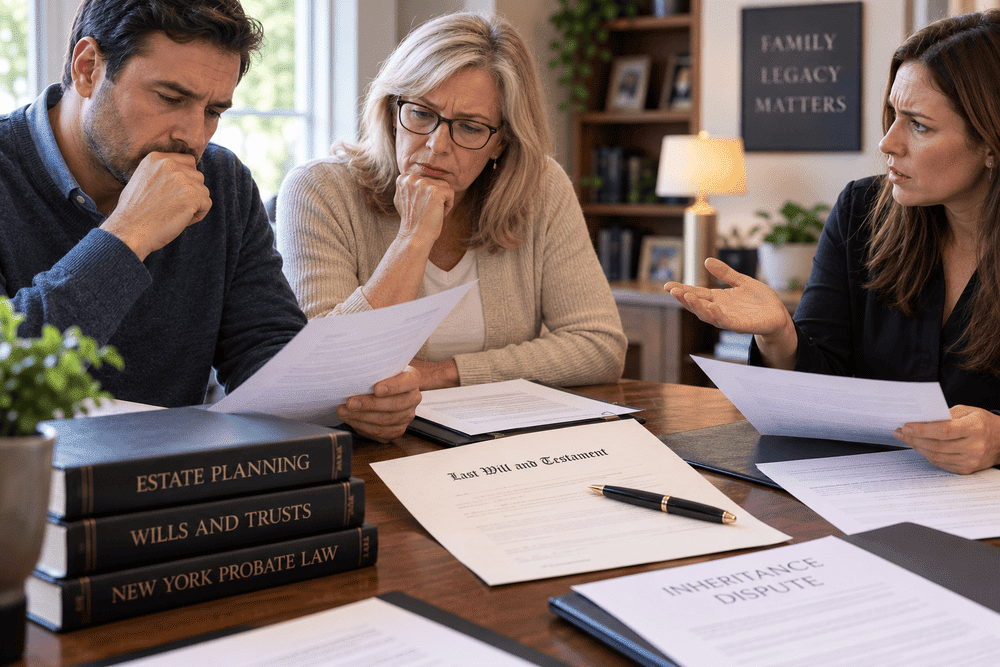
A Last Will and Testament is meant to reflect a person’s final wishes, but having a signed will does not guarantee it will go through probate without any issues. Sometimes, families find unexpected changes, large gifts to one person, or the exclusion of a close relative, which can raise real concerns. New York law lets certain people challenge a will if there is a valid legal reason. Simply being unhappy with an inheritance is not enough to overturn a will. At Bernard Law P.C., we help families in Suffolk County figure out when concerns about a will might justify a legal challenge and when an unusual estate plan is still legally valid.
Challenging a will can involve a lot of details, including witnesses, medical and financial records, past estate planning documents, and statements from the attorney who prepared the will. Before filing any objections, we think it’s important to know both the legal reasons for a challenge and what evidence might support it.
Lack of Testamentary Capacity Can Call a Will Into Question
New York Estates, Powers and Trusts Law § 3-1.1 provides that a person who is at least 18 years old and of sound mind and memory may make a will. Testamentary capacity is therefore fundamental to a valid estate plan.
A capacity challenge does not succeed simply because the person was elderly, physically ill, forgetful, or diagnosed with a medical condition. The more important issue is the person’s mental condition when the will was executed. Generally, the inquiry focuses on whether the testator understood that a will was being made, understood the general nature and extent of his or her property, and understood the natural objects of his or her bounty, meaning the people who would ordinarily be expected to receive consideration in the estate plan.
Timing is critical. A person experiencing cognitive decline may still have sufficient testamentary capacity during a period of lucidity. Conversely, evidence showing severe confusion or inability to understand basic financial and family information near the execution date can become highly relevant. Medical records, witness testimony, prior wills, attorney notes, and communications may all help establish what the testator understood at the time.
Undue Influence Is a Common Allegation in New York Will Contests
Undue influence occurs when another person’s influence becomes so significant that the resulting will reflects the influencer’s wishes rather than the testator’s free and voluntary decisions. This often becomes an issue when an elderly or vulnerable person becomes heavily dependent upon one relative, caregiver, companion, or adviser and then dramatically changes an estate plan in that person’s favor.
Not every form of influence is improper. Children routinely discuss estate plans with parents, spouses influence one another, and caregivers may legitimately develop close relationships with the people they assist. The legal concern arises when influence crosses the line and effectively overcomes the testator’s independent wishes.
Because direct evidence of undue influence is uncommon, these cases frequently depend upon surrounding circumstances. We may examine whether the beneficiary isolated the testator from other family members, controlled access to finances or medical care, participated in arranging the will, communicated privately with the drafting attorney, or received a substantial benefit that departed sharply from prior estate plans.
A sudden change in beneficiaries does not automatically establish wrongdoing. It can, however, justify closer examination when combined with evidence of dependence, vulnerability, and unusual involvement by the person who benefited.
Fraud May Provide Another Basis for Challenging a Will
Fraud differs from undue influence because it generally involves intentional deception. A will may be challenged when someone knowingly misrepresented an important fact to the testator, and that deception caused the testator to make a testamentary decision he or she otherwise would not have made.
Consider a situation in which someone falsely tells an aging parent that another child stole money, abandoned the family, or committed some serious act. If the parent relies upon that lie and removes the child from the will, the resulting disposition may warrant investigation.
Fraud can also concern the document itself. A testator might be misled about what he or she is signing or about the contents of the document.
These cases require evidence connecting the false representation to the estate planning decision. Suspicion alone is rarely enough. Communications, financial records, witness testimony, prior estate plans, and statements made by the testator may become important in determining whether deception actually affected the will.
Improper Execution Can Make an Otherwise Reasonable Will Invalid
New York imposes specific formalities for executing a will. Under Estates, Powers and Trusts Law § 3-2.1, a traditional written will generally must be signed at the end by the testator or by another person acting at the testator’s direction and in the testator’s presence. The testator must acknowledge the signature to the witnesses, declare that the document is his or her will, and have at least two attesting witnesses sign within the required statutory period.
These requirements matter even when there is little dispute about what the deceased person intended. A document that expresses someone’s wishes but was not properly executed may face serious obstacles in probate.
Questions may arise over whether the testator actually signed the document, whether the witnesses were present as required, whether the testator declared the document to be a will, or whether the signature is genuine. A claim that a signature was forged would obviously raise an even more fundamental challenge to authenticity.
When an attorney supervised the execution, and the will contains proper attestation language, overcoming evidence of proper execution may be more difficult. That does not prevent investigation when credible evidence suggests that statutory formalities were not followed.
SCPA 1404 Examinations Can Be Critical Before Filing Objections
A person with concerns about a will does not always have to file formal objections immediately. New York Surrogate’s Court Procedure Act § 1404 provides an important procedure through which certain interested parties can examine witnesses connected with the will before deciding whether to contest probate.
These examinations may include the attesting witnesses and, under appropriate circumstances, the person who prepared the will. The process can provide valuable information about the testator’s condition, how instructions were communicated, who attended meetings, and what occurred during execution.
If the investigation produces evidence supporting a challenge, SCPA § 1410 permits a person whose interest in the estate would be adversely affected by probate to file objections. When a SCPA 1404 examination has been requested, the statute generally requires objections to be filed within 10 days after completion of the examinations unless another period is established by stipulation or court order.
We believe this pre-objection process is particularly important because a will contest should be based on evidence rather than family suspicion alone.
New York Snowbirds May Have Wills Connected to Florida
Families in Suffolk County sometimes encounter another issue when a loved one maintained homes in both New York and Florida. A will may have been signed in Florida even though probate is later sought in New York.
New York EPTL § 3-5.1 addresses wills connected to another jurisdiction. Among other provisions, New York may recognize a written and signed will that satisfies the execution laws of New York, the jurisdiction where the will was executed, or the jurisdiction where the testator was domiciled at the relevant time. Florida Statutes § 732.502 separately establishes Florida’s formal requirements for executing wills.
The existence of property or residence in two states can therefore make the analysis more complicated. We look carefully at domicile, where the will was signed, the applicable execution requirements, and where probate should occur before determining whether there is a valid basis for challenging the document.
Frequently Asked Questions About Challenging a Will in New York
Who Can Challenge a Will in New York?
Not everyone who disagrees with a will has standing to contest it. Under SCPA § 1410, a person generally must have an interest in the testator’s property or estate that would be adversely affected if the will were admitted to probate.
This commonly includes people who would inherit under a prior will or under New York intestacy law if the challenged will were rejected. Determining standing should be one of the first steps before substantial time and expense are devoted to a contest.
Is Being Left Out of a Will Enough to Challenge It?
No. New York law generally allows a person to decide how property will be distributed, subject to certain protections such as a surviving spouse’s statutory rights. Being disappointed, receiving less than expected, or being treated differently from siblings does not by itself make a will invalid.
There must generally be a recognized legal basis such as lack of testamentary capacity, undue influence, fraud, forgery, or failure to comply with execution requirements.
What Evidence Can Help Prove Undue Influence?
Undue influence cases often rely upon circumstantial evidence because coercion rarely occurs in front of independent witnesses. Evidence may include changes between prior and later wills, the testator’s physical or mental vulnerability, dependence upon a beneficiary, isolation from relatives, control over finances, and unusual involvement by a beneficiary in preparing or executing the will.
No single fact necessarily proves undue influence. We generally look at the entire relationship and the circumstances surrounding the estate plan.
Can Someone Challenge a Will Because the Testator Had Dementia?
A dementia diagnosis does not automatically invalidate a will. The relevant question is whether the person possessed testamentary capacity when the will was signed.
Medical records may be important, but they are only part of the evidence. Statements by witnesses, attorney records, the testator’s conduct, and the person’s understanding of property and family relationships can also matter. Capacity can therefore become a much more detailed factual inquiry than simply identifying a diagnosis.
What Happens During a SCPA 1404 Examination?
A SCPA 1404 examination allows certain interested parties to question people involved with the will before formal objections are filed. Attesting witnesses and, depending upon the circumstances, the attorney or other person who prepared the will may be examined.
The testimony can help reveal whether the testator appeared competent, whether required execution procedures were followed, who participated in estate planning meetings, and whether circumstances suggest coercion or other misconduct.
What Happens if a Will Challenge Succeeds?
The result depends upon the nature of the challenge and the estate planning history. If an entire will is denied probate, an earlier valid will may potentially control. If there is no prior valid will, assets subject to probate may pass according to New York’s intestacy laws.
That is why the consequences should be carefully analyzed before litigation begins. Successfully defeating a particular will does not necessarily mean the challenger receives the inheritance he or she expects.
Speak With Bernard Law P.C. About a Questionable Will
Concerns about a loved one’s will should be evaluated carefully and as early as possible. Will contests may involve testamentary capacity, undue influence, fraud, improper execution, disputed signatures, prior wills, and complicated family relationships. We can review the circumstances surrounding the estate plan, explain the probate process, and determine whether the available evidence supports further investigation or formal objections.
At Bernard Law P.C., our office is located in Shoreham, New York, and we assist clients throughout Suffolk County with estate planning, wills, trusts, estate administration, and estate disputes.
If you believe a loved one’s will may not reflect his or her true intentions, or if someone has challenged a will you are seeking to probate, we can help you understand the legal issues and your available options.
Call our Suffolk County estate planning lawyer at Bernard Law P.C. at (631) 378-2500 to schedule a free consultation. We serve individuals and families throughout Suffolk County and can help you determine the appropriate next step in a New York will dispute.