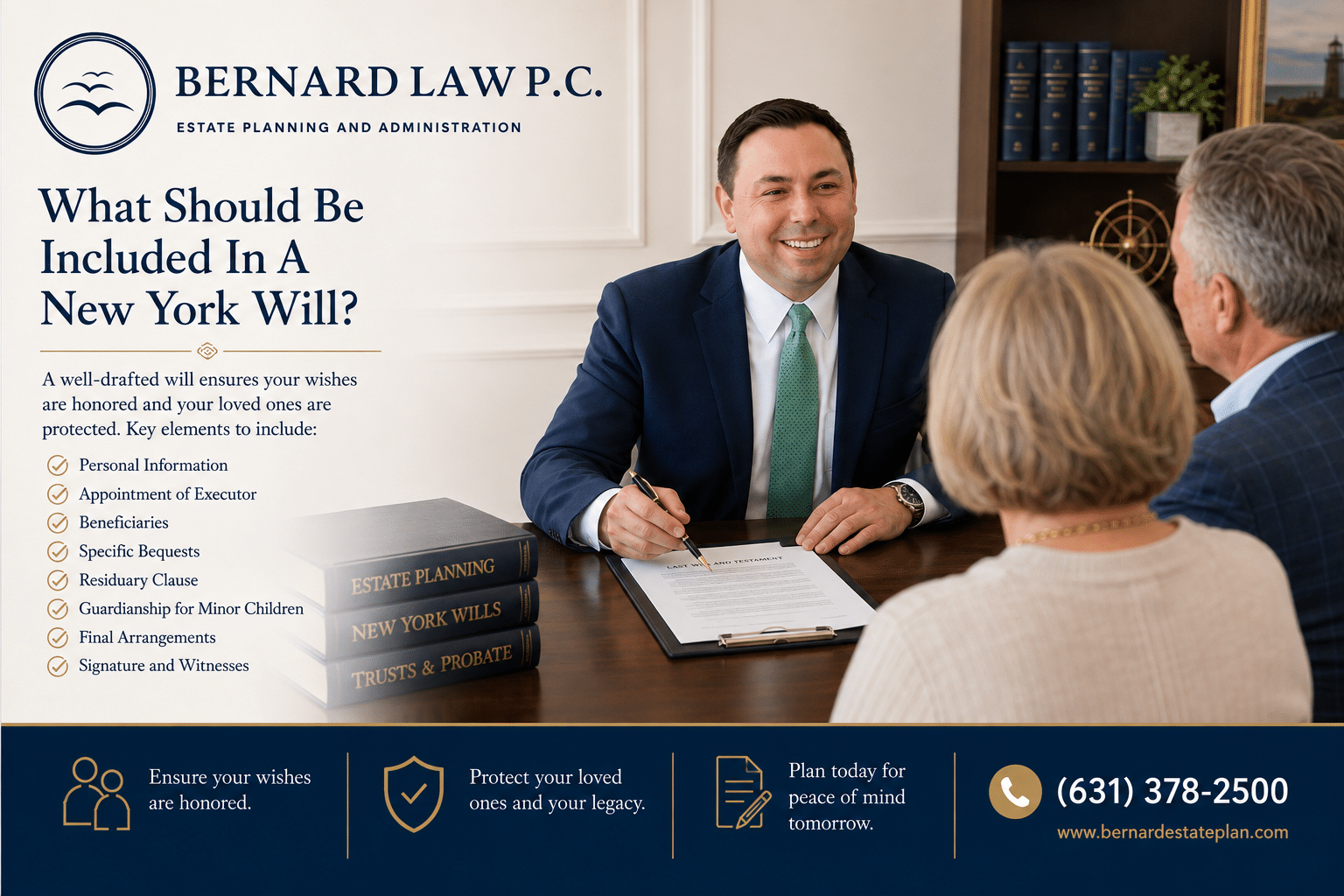
A Last Will and Testament is a key part of any estate plan, but a strong New York will should do more than just list who gets your property. It should clearly explain your wishes, name the people who will carry them out, plan for what happens if a beneficiary passes away before you, and address family situations that might cause confusion. Many clients think that simply listing who should get their home, savings, and belongings is enough. In truth, creating a good will takes more careful thought. If a will leaves questions unanswered, it can lead to family disputes, extra court steps, and costs that estate planning is meant to avoid.
At Bernard Law P.C., we see a will as just one part of your overall estate plan. We review how your assets are owned, check for any beneficiary designations, decide who will manage your estate, and consider if minor or vulnerable beneficiaries need extra protection. We also look at whether trusts should be included. For clients in Suffolk County who spend a lot of time in Florida or own property there, we make sure the will fits into a larger plan that covers both states. Our goal is not just to create a valid document, but to make sure it works as you intend when your family needs it.
A New York Will Must First Satisfy The State’s Legal Requirements
Before considering what provisions should appear in a will, we must make sure the document will qualify as a valid will under New York law. New York Estates, Powers and Trusts Law § 3-1.1 generally permits a person who is at least 18 years old and of sound mind and memory to dispose of real and personal property through a will.
Execution requirements are particularly important. New York EPTL § 3-2.1 establishes the formal requirements for executing and witnessing a will. Among other requirements, the will generally must be signed by the testator and properly attested by at least two witnesses in accordance with the statute. Estate planning documents should therefore not be treated like ordinary contracts that can simply be printed from the internet and signed whenever convenient.
Mistakes made when signing a will can cause big problems after someone passes away, since they are no longer here to explain what they meant. Even if a will clearly states your wishes, it can still cause issues in probate if the legal steps were not followed. Making sure the will is signed correctly and keeping good records of the signing is especially important if a family member later challenges the will.
Your Will Should Clearly Identify Who Receives Your Property
The most familiar function of a will is directing who receives property after death. New York EPTL § 3-1.2 provides that estates in property may be devised or bequeathed by will. The drafting question, however, is not merely who receives something. We also need to determine exactly what each beneficiary receives and what happens if circumstances change before death.
Some clients want to make specific gifts, such as leaving a particular amount of money to a child, a piece of property to a relative, or a charitable gift. Some clients want to leave specific gifts, like a set amount of money to a child, a piece of property to a relative, or a donation to a charity. A well-written will should also include a residuary clause that covers everything left after these gifts, expenses, taxes, and other costs are handled. Without this, any property not mentioned could end up being distributed under New York’s intestacy rules instead of following your wishes. These are questions we prefer to answer while preparing the estate plan rather than leaving them for a Surrogate’s Court proceeding after death.
Choosing The Right Executor Is Just As Important As Choosing Beneficiaries
A New York will should nominate an executor to administer the estate. This person will ultimately have substantial responsibilities, including collecting estate assets, addressing valid debts and expenses, handling tax matters, maintaining estate property, making appropriate distributions, and accounting for the administration of the estate.
We suggest that clients think carefully before simply naming the oldest child or closest relative as executor. The best choice is usually someone who is trustworthy, organized, good with finances, and able to work well with beneficiaries. It is also important to consider family dynamics. If an executor does not get along with other beneficiaries, it could lead to more conflict, even if they are otherwise qualified.
We also help clients name backup executors. If the first choice dies, becomes unable to serve, or declines, the will should say who will take over. If this is not addressed, it can lead to extra court steps to decide who should manage the estate.
New York EPTL § 11-1.1 addresses numerous powers available to fiduciaries in administering estates. A carefully drafted will can work with those statutory powers while also giving the executor appropriate authority to deal with the particular assets and circumstances involved in your estate.
Parents Of Minor Children Need To Address More Than The Inheritance
For parents of minor children, a will serves a purpose that goes well beyond dividing property. It provides an opportunity to express a preference regarding who should care for minor children if both parents die. This is often one of the most personally important decisions contained within the estate planning process.
Parents should also think about whether children should get their inheritance all at once when they come of age. A large inheritance might not be right for a young person who is not used to handling money. In these cases, a will can include trust provisions so a trustee manages the property for the child’s benefit. You can establish how money may be used for education, healthcare, housing, and other needs and determine when or under what circumstances a beneficiary receives greater control. We believe these decisions should reflect the particular child and family rather than relying on an arbitrary age simply because it appears in a standard form.
A Will Should Account For A Surviving Spouse And New York’s Elective Share Rules
Married individuals should not assume they have unlimited freedom to disinherit a spouse through a will. New York provides important statutory protections to surviving spouses.
Under New York EPTL § 5-1.1-A, a qualifying surviving spouse generally has a right of election against the deceased spouse’s estate. The elective share is generally the greater of $50,000 or one-third of the net estate, subject to the detailed provisions and calculations contained in the statute. This becomes particularly important in second marriages, blended families, and estate plans in which a person intends to leave substantial property to children from a prior relationship.
A will should not be created without considering spousal rights. We review all assets, including those that might pass outside the will, when planning for married clients. Trying to handle a complex blended-family situation with just a few lines in a simple will can lead to problems you did not expect.
Your Will Must Coordinate With Assets That Do Not Pass Under The Will
We often remind clients that a will does not control every asset you own. Some property may pass through beneficiary designations, joint ownership, trusts, or other contracts instead of following the will.
For example, if a retirement account names one child as beneficiary but the will states that all property should be divided equally among three children, the beneficiary designation may control the retirement account. Similar issues can arise with life insurance and certain jointly owned financial accounts.
This is why making a will without looking at how all your assets are owned and who the beneficiaries are can lead to a plan that does not work as you expect. We want your will, trusts, account designations, real estate, and other planning tools to work together. Estate planning is most effective when everything is coordinated, not just a set of separate documents.
New York Snowbirds Should Review Their Wills With Both States In Mind
Clients who divide their lives between New York and Florida should pay particular attention to their wills and broader estate plans. Florida generally recognizes a will executed by a nonresident if it was valid under the law of the state or country where it was executed, subject to statutory exceptions and requirements under Florida Statutes § 732.502. Florida law also contains its own rules concerning the execution and self-proof of wills.
However, the fact that a will may be recognized in another state does not mean the overall estate plan is optimized for a New York and Florida lifestyle. The location and ownership of real estate, domicile, beneficiary designations, trusts, tax considerations, and the possibility of estate proceedings in more than one state may all require attention.
We recommend that snowbirds review their estate plans when they buy property in Florida, spend much more time there, change their official residence, or make other big changes to their ties with either state. Your will should stay up to date and be part of a plan that matches your current life, not just an old document.
Call Our Hauppauge Last Will & Testament Attorney For A Free Consultation
A properly prepared will should reflect much more than a list of beneficiaries. It should address who will administer your estate, what happens when circumstances change, how younger beneficiaries will be protected, how the plan affects a surviving spouse, and how the will coordinates with trusts, beneficiary designations, real estate, and other assets.
At Bernard Law P.C., we help clients create estate plans based on their individual families, assets, concerns, and long-term objectives. We also assist New York snowbirds whose estate planning must account for connections to both New York and Florida. Our office is located in Hauppauge, and we serve clients throughout Suffolk County.
If you need to create a New York will, review an existing will, or determine whether your current estate plan still reflects your wishes, we can help you identify the provisions and planning strategies appropriate for your circumstances.
Call our Suffolk County estate planning attorney at Bernard Law P.C. at (631) 378-2500 to schedule a free consultation. We help individuals and families throughout Suffolk County prepare estate plans designed around their lives, families, assets, and future goals.