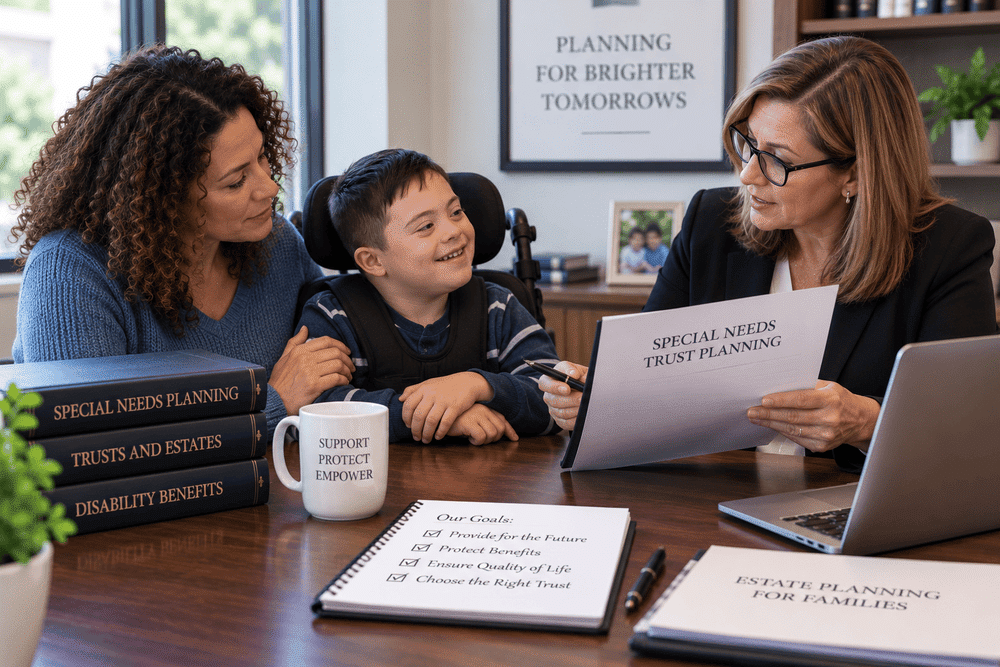
If you have a child with special needs, your estate planning needs are often different from those of other families. You want to make sure your child is financially secure, but giving an inheritance directly can sometimes affect their eligibility for government benefits. You may also need someone to manage these assets after you are gone. Just leaving money in a will can create problems that careful trust planning can help avoid. At Bernard Law P.C., we help families in Suffolk County think about not only how much to leave a child with special needs, but also how those assets should be owned, managed, and distributed.
New York law offers ways to set up trusts that add to government help instead of replacing it. But not every trust works for every family. Things like where the money comes from, what benefits your child gets now or may get in the future, your child’s ability to handle money, and your family’s long-term goals all matter. It’s important to understand these differences before moving any assets.
A Supplemental Needs Trust Can Protect More Than An Inheritance
In New York, what many people call a special needs trust is often referred to legally as a supplemental needs trust. New York Estates, Powers and Trusts Law § 7-1.12 provides a statutory framework for trusts established for people with severe and chronic or persistent disabilities. The basic objective is to permit trust assets to improve a beneficiary’s quality of life without simply replacing government benefits or assistance for which that person may otherwise qualify.
This difference is important because programs like Supplemental Security Income and some types of Medicaid look at a person’s income and resources. If someone gets a large inheritance directly, it could change their finances and affect their eligibility. With a well-designed supplemental needs trust, a trustee can manage the assets for the beneficiary and still consider their eligibility for benefits.
The trustee plays a key role. They do not just give the inheritance to the beneficiary. Instead, they need to understand the trust’s rules, the beneficiary’s needs, and how giving out money might affect public benefits. Picking the right trust means thinking about both the legal setup and who will manage it.
A Third-Party Supplemental Needs Trust Is Often Appropriate For Parents
When parents or grandparents are planning to leave their own assets to a child with special needs, a third-party supplemental needs trust is often an important option to consider. The phrase “third-party” refers to the source of the assets. The beneficiary did not own the property placed into the trust. Instead, another person created and funded the trust for the beneficiary.
Parents can include this type of trust in their will or set it up as a separate trust during their lifetime. Instead of giving the inheritance directly to the child, the estate plan puts the child’s share into the supplemental needs trust. The trustee then uses these assets to help the beneficiary, always keeping in mind how distributions might affect government benefits.
One key benefit of this planning is what happens after the beneficiary passes away. With a well-written third-party trust, the person who set up the trust can choose who gets any remaining property. This is different from some first-party trusts, which may require leftover assets to go to Medicaid. That’s why it’s important to know where the money comes from before choosing a trust.
A First-Party Special Needs Trust Serves A Different Purpose
Sometimes, the person with a disability already owns the money. This might happen after a personal injury settlement, a direct inheritance, or saving up other assets. In these cases, a third-party trust meant for a parent’s property may not be the right solution.
Federal law under 42 U.S.C. § 1396p(d)(4)(A), together with New York Social Services Law § 366(2)(b)(2)(iii), provides a framework under which certain assets belonging to a person with a disability who is under age 65 may be placed into a qualifying trust without the trust corpus automatically being treated as an available Medicaid resource. These trusts have specific requirements, including provisions addressing reimbursement to the state from assets remaining at the beneficiary’s death, up to the applicable amount of medical assistance paid.
The distinction between first-party and third-party money should not be treated as a technicality. Putting the wrong assets into the wrong trust can alter the planning result. When we structure an estate plan, we want to identify the source of every significant asset and determine how it should ultimately pass to the beneficiary.
A Pooled Trust May Be Another Option
Federal and New York law also recognize qualifying pooled trust arrangements. Under 42 U.S.C. § 1396p(d)(4)© and New York Social Services Law § 366, a qualifying pooled trust is established and managed by a nonprofit association. Separate accounts are maintained for individual beneficiaries, while assets may be pooled for investment and management purposes.
A pooled trust can be useful in circumstances where establishing and administering an individual trust may not be practical. However, families should understand the organization’s administrative rules, fees, distribution procedures, and what happens to remaining funds after the beneficiary’s death before selecting this option.
We do not believe families should choose a trust simply because it carries the label “special needs trust.” The structure must fit the beneficiary, the assets, and the family’s goals.
New York And Florida Families Need Coordinated Planning
Families with connections to both New York and Florida should also consider whether a change in residence could affect administration of the plan. Florida has its own trust code under Chapter 736 of the Florida Statutes, and Florida Statutes § 736.04117 expressly recognizes the concept of a supplemental needs trust in its trust-modification and decanting provisions.
The Right Trust Begins With The Child’s Actual Needs
There is no universal special needs trust that we can simply insert into every estate plan. We need to understand the beneficiary’s abilities, current benefits, future care requirements, family relationships, expected inheritance, and long-term financial needs.
Frequently Asked Questions About Special Needs Trusts In New York
Will Leaving Money Directly To My Child Affect Government Benefits?
It can. Eligibility for some programs is based partly on the applicant’s income and available resources. If a child who depends on means-tested benefits receives a significant inheritance outright, the inheritance may affect eligibility.
What Is The Difference Between A First-Party And Third-Party Special Needs Trust?
The primary distinction is who owned the money before it entered the trust. A third-party trust generally contains assets belonging to someone other than the beneficiary, such as a parent or grandparent. A first-party trust contains assets that belong to the beneficiary.
Should I Leave My Child’s Inheritance To A Sibling To Manage Informally?
We generally discourage relying solely on an informal arrangement. Leaving assets outright to another child with instructions to “take care of” a sibling can expose those assets to that person’s creditors, divorce, financial problems, death, or change of circumstances.
A trust creates legally enforceable duties and identifies how assets should be managed. It can also provide successor trustees if the original trustee becomes unable or unwilling to serve.
Who Should Serve As Trustee Of A Special Needs Trust?
The right trustee should be financially responsible, trustworthy, willing to follow the trust terms, and capable of understanding how distributions may affect the beneficiary. A sibling can sometimes be appropriate, but family relationships alone should not determine the decision.
Depending upon the size and complexity of the trust, families may also consider a professional or institutional trustee. We discuss the practical responsibilities with clients before they make this decision because the trustee may serve for decades.
Can A Special Needs Trust Pay For Anything The Beneficiary Wants?
Not necessarily. The terms of the trust and the beneficiary’s benefit programs must be considered before distributions are made. Certain distributions can affect means-tested benefits differently than others.
What Happens To The Trust When My Child Dies?
The answer depends significantly on the type of trust. A third-party supplemental needs trust can generally identify remainder beneficiaries who receive assets after the child dies. Parents may choose siblings, grandchildren, charities, or other beneficiaries.
Certain first-party trusts are different. Federal and New York Medicaid rules generally require qualifying first-party trusts to provide for reimbursement to the state from remaining assets, subject to the applicable statutory requirements.
Call Our Special Needs And Estate Planning Attorney In Shoreham For A Free Consultation
Planning for a child with special needs requires more than deciding who should receive your property. We must consider how an inheritance will be managed, whether public benefits need to be protected, who will serve as trustee, and what will happen when you are no longer available to provide support personally. At Bernard Law P.C., we help families create individualized estate plans that address both present concerns and long-term needs.
If you are planning for a child with special needs, we can help you evaluate third-party supplemental needs trusts, first-party trusts, pooled trusts, wills, beneficiary designations, and other estate planning options based on your family’s circumstances. Bernard Law P.C. is located in Shoreham, New York, and serves individuals and families throughout Suffolk County. Call our Suffolk County estate planning attorney at Bernard Law P.C. at (631) 378-2500 to schedule a free consultation.