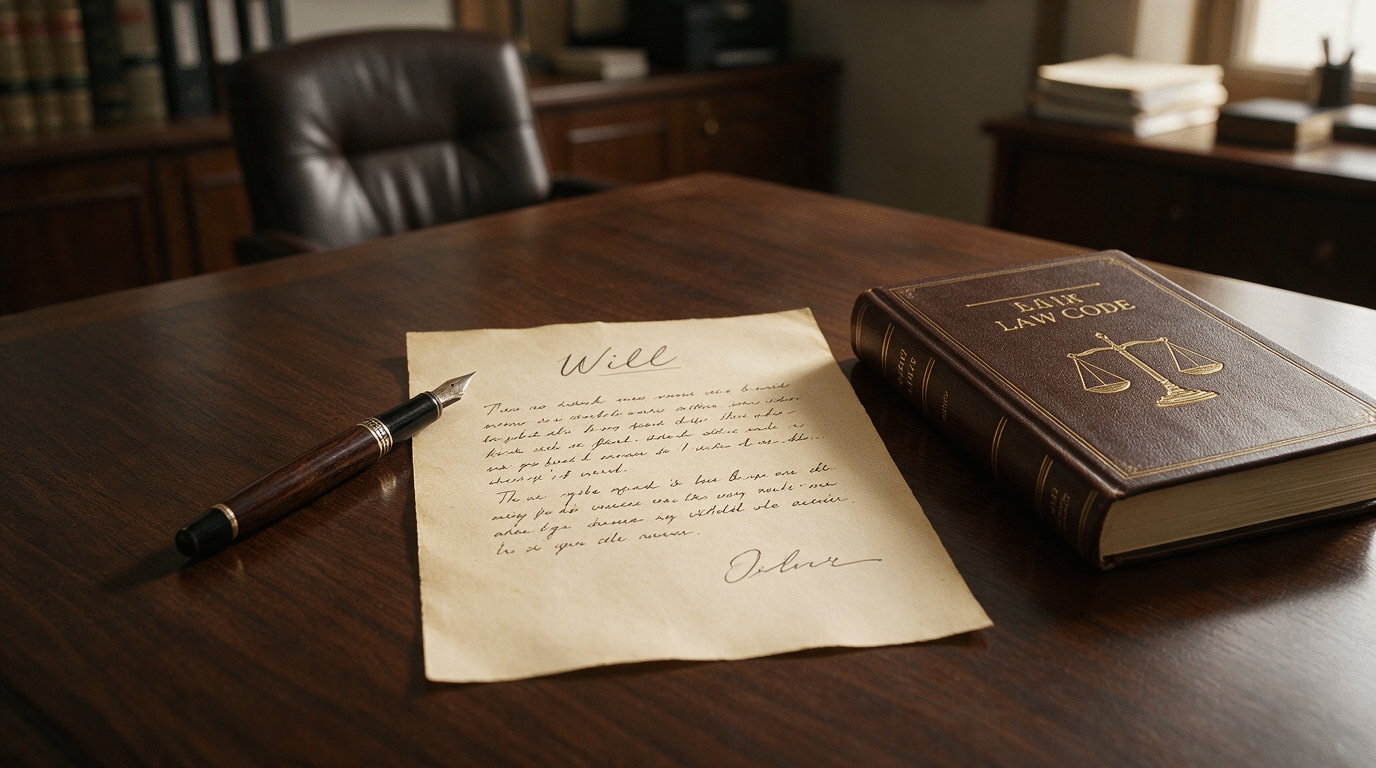
Someone might write out their wishes by hand, sign the paper, and think they have made a valid will. But in New York, handwriting alone usually is not enough to make a will legally binding. The state has specific rules for making wills, and if these are not followed, the document may not control the estate at all. While New York does allow a small number of handwritten, or holographic, wills, this exception is rare. We often tell clients that simply writing down your wishes is not enough. The will must also meet New York’s legal requirements to be accepted by Surrogate’s Court.
At Bernard Law P.C., we help people in Shoreham and across Suffolk County create estate plans that make things clearer for their families after they pass away. Knowing how New York handles handwritten wills is important because even a small mistake can mean property is not given out as you intended, but instead follows state law.
A Handwritten Will Is Not Automatically Invalid
The important distinction is between a will that happens to be handwritten and what New York law calls a “holographic will.”
A person can prepare an ordinary will entirely by hand and still have a valid New York will if the document satisfies the normal execution and witnessing requirements. New York Estates, Powers and Trusts Law § 3-2.1 generally requires a will to be in writing, signed at the end by the testator, and properly witnessed by at least two attesting witnesses. The testator must also communicate to the witnesses that the document is the testator’s will, and the witnesses must sign within the statutory period.
Therefore, using handwriting instead of a computer does not itself create the problem. The real question is whether the required execution formalities were followed.
This distinction matters because someone may write an entire will in a notebook, sign the bottom, and place it in a desk drawer. Unless the statutory requirements were satisfied or a narrow exception applies, that document may not qualify as a valid New York will.
New York Allows Holographic Wills Only In Limited Circumstances
New York EPTL § 3-2.2 defines a holographic will as one written entirely in the testator’s handwriting but not executed and witnessed according to the usual requirements of EPTL § 3-2.1.
New York does not generally recognize such wills for ordinary residents. The statute limits them primarily to certain members of the United States Armed Forces while engaged in actual military or naval service during war or another armed conflict, certain people serving with or accompanying those armed forces, and mariners while at sea.
Even these exceptional wills do not necessarily remain valid indefinitely. EPTL § 3-2.2 establishes time limitations that can cause them to become invalid after the qualifying circumstances end. For example, the statute generally provides a one-year period following discharge for qualifying armed forces members and a three-year period for a qualifying mariner after the will was made, subject to additional rules involving testamentary capacity.
For most New York residents, therefore, writing and signing a will without witnesses is not a safe substitute for properly executing a will.
What Happens If Surrogate’s Court Rejects The Handwritten Will?
The consequences can be substantial. If the handwritten document does not qualify as a valid will and no earlier valid will exists, the individual may be treated as having died intestate.
New York EPTL § 4-1.1 determines how property passes when someone dies without a valid will. Those rules may distribute property very differently from what the deceased person intended.
For example, someone may have written that a particular child should receive a larger share, that property should pass to a longtime partner, or that a friend should receive a valuable possession. If the writing is legally ineffective, those instructions may not control.
An invalid handwritten document can also create estate litigation. One family member may argue that it represents the deceased person’s true intentions while another argues that New York’s execution requirements were never satisfied. That dispute can increase legal expenses, delay estate administration, and deepen existing family disagreements.
Handwritten Changes To An Existing Will Can Also Cause Problems
Another concern arises when someone already has a properly executed will but later writes changes onto it.
A person might cross out a beneficiary, write a different name in the margin, change a percentage, or attach a handwritten note stating that certain property should go to someone else. These seemingly simple changes can create serious legal uncertainty.
Under New York EPTL § 3-4.1, changing or revoking provisions of a will generally requires compliance with legally recognized methods. A written alteration ordinarily must satisfy will-execution formalities if it is intended to operate as a testamentary change. Simply writing instructions on an existing will does not necessarily create a valid amendment.
A formal amendment to a will, commonly called a codicil, must generally be executed with the same type of care as the original will. When circumstances change, preparing a new will or properly executed codicil is usually much safer than making handwritten edits.
Snowbirds Should Be Particularly Careful With Handwritten Wills
Clients who divide their time between New York and Florida should not assume that a handwritten document will become valid simply because it was created in another state.
Florida Statutes § 732.502 also requires wills to satisfy execution and witnessing formalities and does not recognize an unwitnessed holographic will merely because it is entirely in the testator’s handwriting. A handwritten Florida will can be valid when it complies with Florida’s formal execution requirements, but handwriting alone does not eliminate the need for witnesses.
For snowbirds, inconsistent documents created in different states can create questions about which document controls and whether a later writing validly changed an earlier estate plan. Coordinated planning is particularly important when a person owns real estate, maintains significant financial accounts, or spends substantial time in both states.
A Will Should Remove Uncertainty, Not Create It
The purpose of a well-prepared will is to provide clear and legally enforceable instructions. A handwritten document prepared without understanding New York’s requirements may accomplish the opposite.
We encourage clients to treat execution formalities as an important part of estate planning rather than a technical detail. A carefully prepared will can address beneficiaries, executor appointments, guardianship concerns, tax planning, and numerous other issues that a short handwritten document may overlook.
The goal is not simply to leave instructions behind. The goal is to leave instructions that New York law will recognize and that your family can carry out with as little uncertainty as possible.
Speak With Bernard Law P.C. About Creating A Valid New York Will
A will should give your family clarity about your wishes rather than leave them with questions about whether a handwritten document is legally enforceable. At Bernard Law P.C., we help clients create individualized estate plans that address their assets, family relationships, long-term objectives, and concerns about future estate administration. We also assist snowbirds who need coordinated planning involving New York and Florida.
If you are considering creating a will, replacing an old will, correcting handwritten changes, or reviewing an existing estate plan, Bernard Law P.C. can help. Our law office is located in Shoreham, New York, and we serve individuals and families throughout Suffolk County.
Call our Suffolk County estate law attorney at Bernard Law P.C. at (631) 378-2500 to schedule a free consultation and discuss how properly prepared estate planning documents can protect your wishes, your property, and the people you care about.