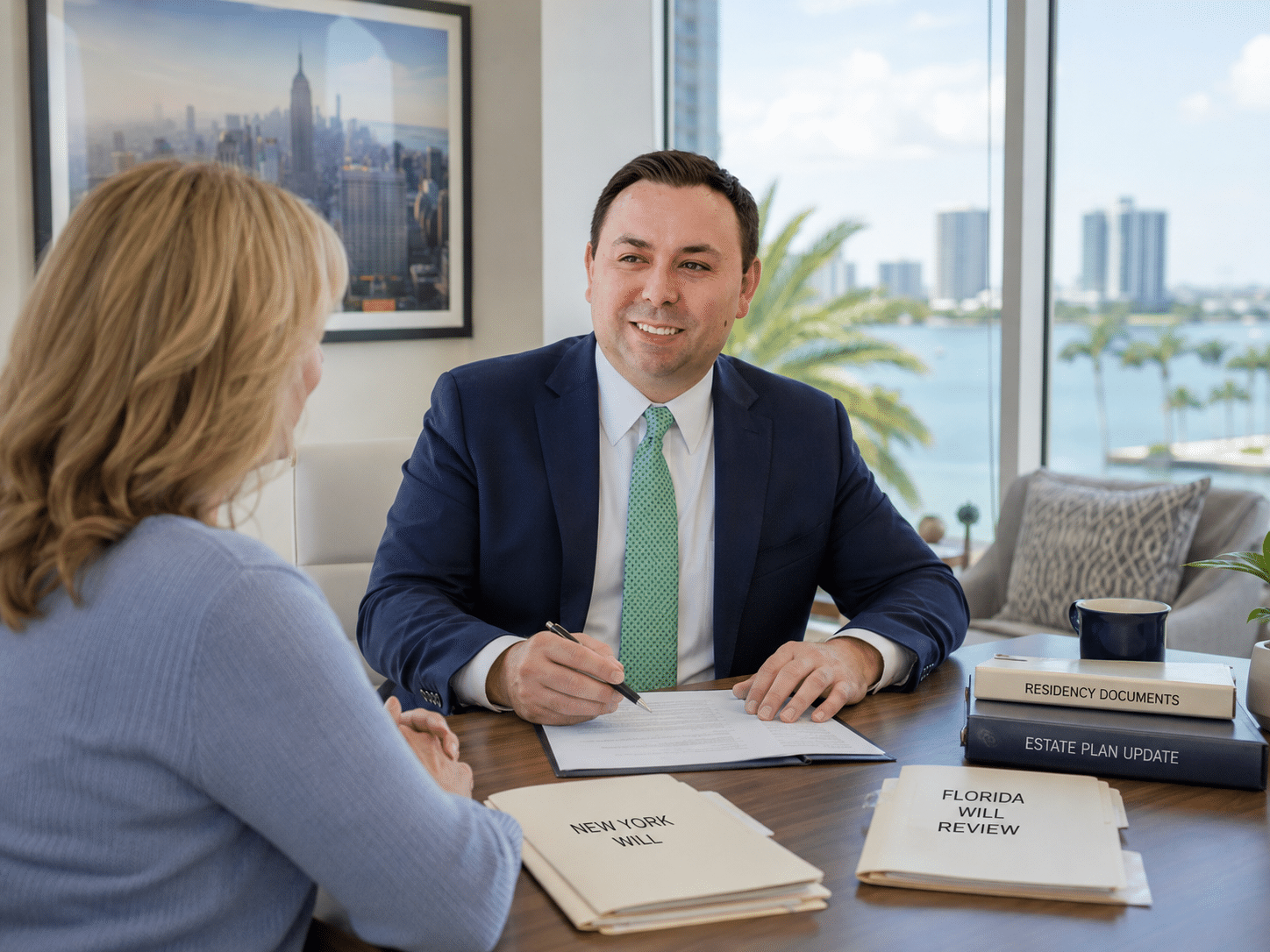
When you move from New York to Florida, more changes than just your address. Your estate may be handled differently; different state laws could apply to your property, and your Florida home might pass to heirs in new ways. Documents you signed years ago may not work as you intended. Many New Yorkers think moving to Florida cancels out their New York will, but that’s usually not true. Still, just because a will is valid doesn’t mean it fits your new situation. That’s why we recommend reviewing your entire estate plan when you make Florida your permanent home.
At Bernard Law P.C., we see this issue often because many of our clients split their lives between New York and Florida. Some move to Florida but still own a home or investments in Suffolk County. Others spend part of the year in Florida but keep strong connections to Suffolk County. If you live in more than one state, it’s important to review your estate plan as a whole, not just check if your old New York will is still valid.
Your New York Will Does Not Automatically Become Invalid When You Move
A properly executed New York will generally does not cease to exist simply because you move to Florida. New York Estates, Powers and Trusts Law § 3-2.1 establishes New York’s formal requirements for executing and witnessing a will. New York EPTL § 3-5.1 also addresses wills connected with more than one jurisdiction and recognizes, in specified circumstances, wills executed in accordance with the law of another relevant jurisdiction.
Florida similarly recognizes many wills executed outside the state. Florida Statutes § 732.502 provides that, with important exceptions for certain holographic and nuncupative wills, a will executed by a nonresident can be valid in Florida when it was valid under the law of the state or country where it was executed.
We don’t suggest putting your New York will away and thinking your planning is done after moving to Florida. The real question is whether your will still fits your property, family situation, residency, and estate planning goals. Moving is a major life event that should prompt you to review your estate plan.
Florida Homestead Law Can Change The Estate Planning Analysis
If you buy a home or make it your Florida homestead, pay special attention. Florida’s homestead protections can have a big impact on your estate planning.
Florida Statutes § 732.4015 restricts the ability to devise homestead property when the owner is survived by a spouse or minor child. Depending upon the family circumstances, a provision in an older will concerning a residence may not operate in the manner the owner expects after the property becomes Florida homestead.
Florida Statutes § 732.401 also provides statutory rules governing the descent of homestead when it is not validly devised. For example, particular rights can arise when the deceased owner leaves a surviving spouse and descendants.
This shows why we don’t just check if your old will is legally valid. Your property may now have rights and restrictions that didn’t exist when you first made your will in New York.
If you’ve moved to Florida, bought a home there, remarried, or changed how your homes are owned, it’s important to review your estate plan carefully.
Your Spouse’s Rights May Also Be Different In Florida
Moving can also affect the rights of a surviving spouse. New York provides a surviving spouse with a statutory right of election under Estates, Powers and Trusts Law § 5-1.1-A. This means estate planning for a married New Yorker cannot simply ignore the surviving spouse’s rights by leaving that spouse out of a will.
Florida has its own elective-share system. Florida Statutes § 732.201 provides a surviving spouse of a person who dies domiciled in Florida with the right to an elective share of the deceased spouse’s elective estate.
The systems are not identical. That matters when someone creates an estate plan in New York, later establishes domicile in Florida, and assumes the original distribution plan will operate exactly as originally anticipated.
This is especially important for second marriages and blended families. If you or your spouse have children from previous relationships, your estate plan should balance the rights of your surviving spouse with what you want your children and other beneficiaries to receive.
Do Not Review Your Will Without A Legal Professional
When clients ask us to review their will after moving to Florida, we look at more than just the will. Today’s estate plans often rely on several documents and how your assets are arranged.
For example, your will usually doesn’t control retirement accounts with named beneficiaries. It may not cover jointly owned property or assets in a trust. Powers of attorney and healthcare documents help if you become incapacitated, not for passing property after death. Trusts can also be important if you own property in more than one state.
For former New Yorkers, this coordinated review can be particularly valuable. A person may have a Florida primary residence while retaining a Suffolk County vacation home or investment property. Real estate located in New York raises different considerations because New York EPTL § 3-5.1 provides that issues concerning testamentary dispositions of real property are generally determined by the law of the jurisdiction where that property is located.
Your goal should be to have one coordinated estate plan, not separate documents that might conflict with each other.
Establishing Florida Domicile Deserves Careful Attention
There is also an important difference between spending the winter in Florida and actually changing your domicile to Florida.
A person may spend significant time in Florida without completely severing New York connections. Estate administration and tax questions can become more difficult when someone’s actions and documents do not clearly reflect where that person intended to make a permanent home.
For someone genuinely moving from New York to Florida, estate planning documents should be reviewed alongside other evidence of the relocation. The address appearing in a will is not, standing alone, what determines domicile. Your homes, financial affairs, important personal connections, and other circumstances can become relevant.
This is especially significant for higher-value estates because state domicile can have important tax consequences. A carefully coordinated plan should account for those issues rather than treating the move as nothing more than an address change.
Updating A Will Is About Improving The Plan, Not Merely Replacing A Document
We do not believe every New Yorker who moves to Florida should automatically discard a properly drafted will simply because it was signed in New York. We do believe the move creates a strong reason to have the entire estate plan reviewed.
The review may reveal that the will remains appropriate. It may instead show that provisions should be revised because of Florida homestead law, marital rights, newly acquired property, changed beneficiaries, a different executor, or the use of trusts. It may also reveal inconsistencies between the will and beneficiary designations that have nothing to do with the move itself.
For snowbirds and former New Yorkers, good estate planning requires us to understand the whole picture. Where you live, where you own property, who you want to protect, and how you want assets administered after death are all parts of the same discussion.
FAQs About Updating A New York Will After Moving To Florida
Is My New York Will Still Valid If I Move To Florida?
A properly executed New York will can generally continue to be recognized after a move to Florida. Florida Statutes § 732.502 recognizes many wills executed by nonresidents when the wills were validly executed under the applicable law where they were signed.
However, continuing validity does not necessarily mean the document remains the best estate plan for you. Florida homestead law, surviving-spouse rights, newly acquired Florida property, and changes in domicile may affect how the overall plan operates. We therefore recommend reviewing the entire estate plan rather than assuming that legal validity ends the analysis.
Should I Sign A New Will Immediately After Becoming A Florida Resident?
Not necessarily immediately, but establishing a new domicile is an excellent time for a legal review. The decision to replace or revise the will should depend upon what the existing document says, your current assets, your family circumstances, and what you want the plan to accomplish.
If a new will is appropriate, it should be prepared carefully. Simply creating another document without properly revoking or coordinating the previous will can create confusion rather than solving it.
What If I Still Own A House On Long Island?
Continuing to own New York real estate is especially important. New York EPTL § 3-5.1 provides rules concerning wills involving property across jurisdictions and generally looks to the law where real property is situated for certain issues involving that property.
We would therefore want to understand how the Long Island property is titled, who should receive it, and whether a trust or another ownership structure is appropriate. Keeping property in both New York and Florida makes coordinated estate planning particularly valuable.
Does Becoming A Florida Resident Eliminate New York Estate Tax Concerns?
Not necessarily. Changing your domicile can have significant tax consequences, but calling yourself a Florida resident does not automatically resolve every New York tax issue. Property located in New York can continue to create New York considerations, and domicile itself can become disputed depending upon the facts.
For clients with substantial estates, we believe residency planning and estate tax planning should be considered together. This is particularly important for people who maintain significant financial and personal ties to both states.
Should I Update My Trust And Power Of Attorney Too?
Yes, they should at least be reviewed. Moving to another state should trigger a review of the entire estate plan, including wills, trusts, powers of attorney, healthcare documents, deeds, and beneficiary designations.
Looking only at the will can leave major gaps. Our goal is to determine whether all components of the plan continue working together after the move and whether they still reflect your current wishes.
Contact Us For Estate Planning For New York And Florida Snowbirds
Moving from New York to Florida is a significant life change, and your estate plan deserves the same attention as the other financial and legal matters associated with that move. At Bernard Law P.C., we help clients evaluate how wills, trusts, beneficiary designations, real estate ownership, tax planning, and incapacity documents work together when their lives involve both New York and Florida.
Our office is located in Hauppauge, New York, and we serve individuals and families throughout Suffolk County. We understand that snowbird planning is rarely a matter of simply changing an address on an old document. The objective is to create a coordinated plan that reflects where you live now, the property you continue to own, and the people you want to protect.
If you have moved to Florida, are preparing to relocate, or divide your time between New York and Florida, we can review your existing estate plan and identify issues that may deserve attention. Careful planning now can reduce uncertainty for you and your family later.
Call our Suffolk County wills lawyer at Bernard Law P.C. at (631) 378-2500 to schedule a free consultation. Our law office is located in Hauppauge, New York, and we serve clients throughout Suffolk County with estate planning, wills, trusts, estate administration, estate tax planning, and snowbird estate planning matters.